

LED
LED is the abbreviation for Light Emitting Diode. An LED is a semiconductor device that converts electrical energy into light. When an electric current flows through the semiconductor, energy is emitted in the form of light. This process is known as electroluminescence.
Advantages of LEDs
LEDs achieve high luminous efficacy and can utilise a large proportion of the electrical power they consume to produce light. Compared with conventional incandescent and halogen lamps, this enables them to produce a higher luminous flux for a comparable power consumption.
Further advantages include their compact design, potentially long service life, short switching times and good controllability. Due to their small light-emitting area, the light produced can also be precisely shaped using optical systems. These properties make LEDs particularly suitable for vehicle headlights, work lights and warning lights.
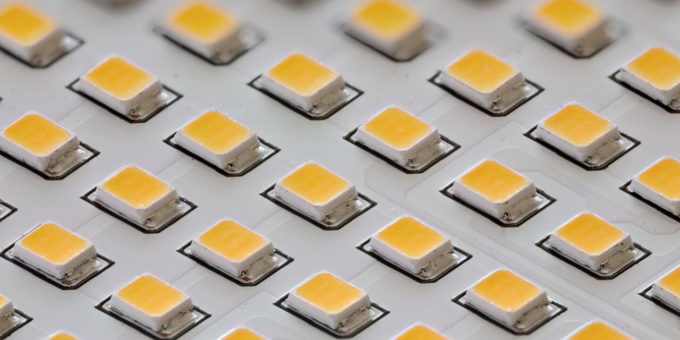
Light colour of an LED
The light colour that an LED produces directly depends on the semiconductor materials used and their bandgap. LEDs can therefore produce light of different wavelengths.
A single LED does not, by itself, produce the entire spectrum of white light. In white LEDs, short-wavelength light from an LED is often partially converted into longer-wavelength light with the aid of a phosphor. This mixture creates the impression of white light. White light can also be produced by mixing different LED colours.
The perceived colour of white light can be described by its colour temperature. The colour rendering index, amongst other factors, describes how faithfully colours appear under the light.
LED designs
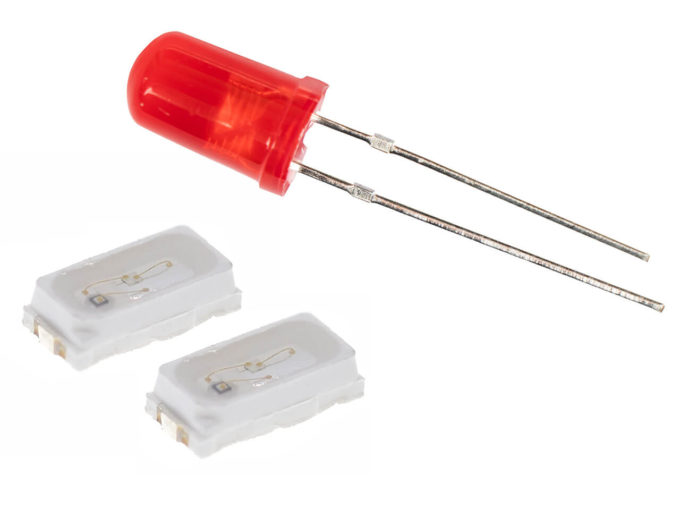
LEDs are available in various designs. Traditional through-hole LEDs have their lead wires passed through holes in a printed circuit board and soldered in place. They are still used today, for example, for display and signalling functions.
SMD LEDs are frequently used in modern lighting applications. SMD stands for Surface Mounted Device. These components are mounted directly onto the surface of a printed circuit board and enable compact designs as well as efficient industrial production.
Another type is the COB LED. COB stands for Chip on Board. In this design, several LED chips are arranged directly on a shared substrate and electrically connected. This technology enables a high packing density of the individual light sources. In the case of COB LED strips, this can result in an almost continuous line of light, in which individual light points are significantly less noticeable than with many conventional SMD LED strips.
However, the design alone says nothing about an LED’s luminous flux, efficiency or performance.
Heat generation and temperature behaviour
LEDs do not convert all the electrical energy they absorb into visible light either.
Some of the energy is dissipated as heat. Unlike in an incandescent lamp, where light is produced by a heated filament, a considerable amount of waste heat can still be generated, particularly in high-power LEDs.
The temperature of the semiconductor also influences its photometric properties. As the operating temperature rises, the luminous flux generated may decrease. A persistently high temperature can also accelerate the ageing of the LED.
Effective heat dissipation is therefore an essential component of high-performance LED lights. Heat sinks and other thermal management measures dissipate the heat generated from the LED module and limit the operating temperature.
Service life of LEDs
The service life of an LED cannot be described solely in terms of the point at which it fails completely. LEDs typically experience a gradual decline in luminous flux over their operational lifetime. This process is known as luminous flux or LED degradation.
So-called L-values are used, amongst other things, to describe this behaviour. L70, for example, refers to the point in time or the operating duration at which the luminous flux of an LED has fallen to 70 per cent of its original value. Similarly, L50 refers to a remaining luminous flux of 50 per cent.
An LED may continue to function at this point. Rather, the respective threshold value serves to define the useful lifetime for a specific application.
In addition to this gradual ageing, complete failures are also possible. In the case of an LED light, it is not only the LEDs themselves that determine the service life of the entire product. Driver electronics, electrical components, seals, thermal stresses and other components can also limit the actual service life.