

LED degradation
LED degradation refers to the gradual decline in an LED’s performance over its operational lifetime. For lighting applications, the decline in luminous flux is of particular significance.
Unlike traditional light sources, LEDs do not necessarily fail abruptly at the end of their service life. Their light output may gradually decrease over many hours of operation. Parameters such as L70, L80 or L90 are used, amongst others, to describe this trend.
What does a service life of 50,000 hours mean?
The common practice of specifying a service life in operating hours is, on its own, of limited significance. In the case of LEDs, it is also important to know which criterion is still met after this operating period.
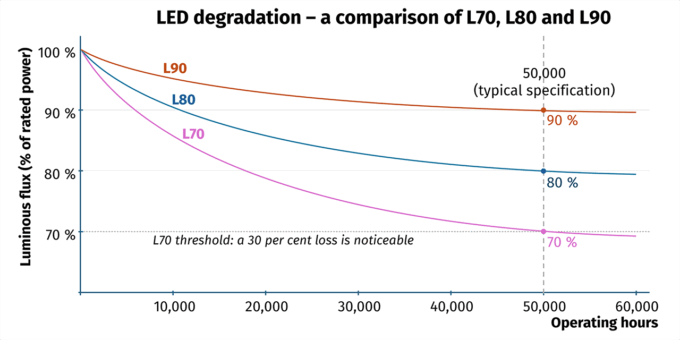
So-called L-values are used for this purpose, amongst other things. The number following the ‘L’ describes what proportion of the original luminous flux is still achieved:
- L90: 90 per cent of the original luminous flux
- L80: 80 per cent of the original luminous flux
- L70: 70 per cent of the original luminous flux
A specification such as L70 at 50,000 hours therefore describes a useful service life based on a luminous flux maintenance of 70 per cent. It does not mean that the LED will suddenly fail after 50,000 hours. Such specifications are also used in current technical product data.
L and B values
As not all LEDs or LED products age in exactly the same way, LED degradation can also be described statistically for a population. The notation LxBy is used for this purpose. The L-value indicates the underlying luminous flux retention. The B-value describes the proportion of products still in operation within a given population that have fallen below this luminous flux value at that point in time.
L80B10, for example, means that at the specified point in time, 10 per cent of the products still in operation have fallen below the specified luminous flux retention of 80 per cent.
B50 denotes the median: at this point in time, 50 per cent of the population under consideration that are still functioning have fallen below the respective L-value. This so-called median useful life is often simply denoted as Lx, for example L80 instead of L80B50.
The B-values should not be equated with total failures. A product that falls below the specified luminous flux value may still function and produce light. Total failures are considered separately in the assessment of service life.
Influence of temperature
The ageing of LEDs depends on the respective operating conditions. Thermal stress, in particular, plays an important role in LED degradation. High operating temperatures can accelerate ageing processes and thus influence luminous flux degradation.
Suitable thermal management is therefore essential for high-power LED lights. Heat sinks and other design measures dissipate the resulting waste heat and help to maintain the temperatures of the LED and other electronic components within the specified operating conditions.
Lifetime specifications must therefore always be considered in the context of the underlying operating and temperature conditions. In actual product specifications, the service life is frequently stated in conjunction with a specific ambient temperature.
Service life of the LED and the light
The service life of an LED must not automatically be equated with the service life of a complete LED light.
In addition to the LEDs, a light contains other components such as driver electronics, printed circuit boards, optical components, seals and electrical connections. Their ageing or failure can also limit the service life of the entire product.
A high specified service life for the LED alone does not therefore mean that the complete light will achieve the same operating life. When assessing an LED product, both the gradual degradation of luminous flux and possible failures of the overall system must be taken into account.