

COB-LED
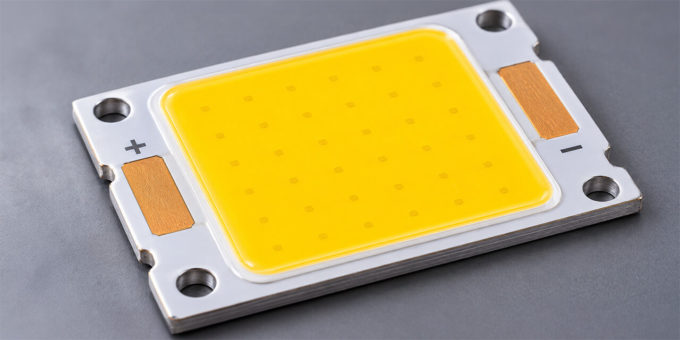
COB stands for ‘Chip on Board’ and refers to a design in which LED chips are mounted directly onto a common substrate or printed circuit board and electrically connected. Unlike with an SMD LED, the individual LED chips are not first housed in separate casings, which are then attached to the printed circuit board.
In this way, several LED chips can be arranged very closely together and covered jointly with a phosphor or encapsulant layer. As a result, the COB LED often appears to the observer as a continuous luminous surface, even though it consists of several individual LED chips.
Properties of COB LEDs
The direct mounting of the chips allows a large number of LEDs to be accommodated within a comparatively small area. At the same time, the heat generated can be dissipated directly to the common substrate. However, how effectively the heat is actually dissipated depends on the overall design and the thermal management of the product.
COB initially refers only to the construction and assembly technique. The designation alone does not provide any information about the luminous flux, efficiency, colour rendering index or service life of an LED.
COB in LED strips
In LED strips, COB technology is used to arrange a large number of small LED chips at close intervals on a flexible substrate. A phosphor or encapsulant layer applied over this can create an almost continuous light-emitting surface. As a result, individual light points are less clearly visible than in LED strips with SMD LEDs spaced further apart. This can create a more uniform visual appearance, particularly when viewed directly or in the case of flat profiles and covers.
However, COB is not inherently ‘better’ than SMD. Which design is more suitable depends, amongst other things, on the desired light distribution, power, heat dissipation, design and application.