

Fog light
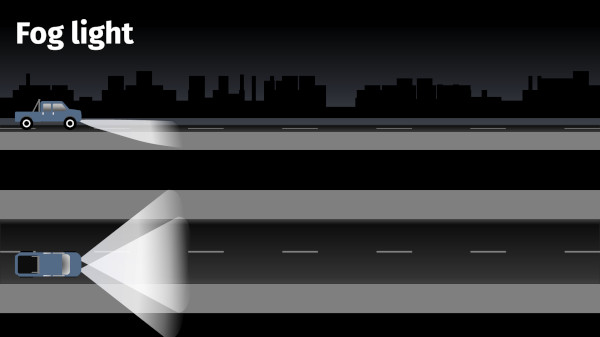
Fog lights are a special lighting function of headlights designed for use in poor visibility conditions. Front fog lights produce a wide beam pattern with light output that is clearly limited at the top.
This illuminates, in particular, the area of the road in front of and to the sides of the vehicle, whilst limiting unwanted light above the intended beam pattern.
Beam pattern of a fog light
The beam pattern of a fog light differs from both low beam and high beam.
It is characterised by a wide light distribution with a defined cut-off line. Light emission above this line is limited. The exact photometric requirements are laid down by the relevant ECE regulations.
Further typical light distributions are shown in the article beam patterns of headlights.
Fog and scattered light
Fog consists of numerous tiny water droplets which scatter light. Light emitted in the direction of these droplets can therefore be partially scattered back towards the driver, impairing visibility.
A fog light does not prevent this light scattering. However, its specifically designed light distribution limits light emission above the cut-off line in particular.
What is therefore crucial is not simply a particularly high light output, but a light distribution suitable for this purpose.
Fog lights and rear fog lights
The front fog light must not be confused with the fog tail light.
Fog lights are used to illuminate the road ahead of the vehicle. The rear fog light, on the other hand, is a signal light at the rear of the vehicle. It is intended to make the vehicle more visible to following road users when visibility is severely restricted.
Legal requirements
Front fog lights are subject to defined photometric requirements. Within the scope of the ECE regulations, UN Regulation No. 149 in particular sets out requirements for light distribution, luminous intensity and the cut-off line. Requirements regarding mounting and wiring on the vehicle are governed, amongst other things, by UN Regulation No. 48.
A fog light that has been type-approved in accordance with these requirements bears an ECE test mark as well as further indications on the lamps, which identifies its approved function.