

Wagner hammer
The Wagner hammer is an electromechanical interrupting contact. It generates repetitive electrical pulses by rapidly switching on and off. This principle is achieved using an electromagnet and a movable contact.
The name comes from the German physicist Rudolf Wagner. In the past, the Wagner hammer was used in devices such as horns, bells, relays, buzzers, and ignition systems.
Construction of a Wagner Hammer
A Wagner hammer typically consists of the following components: The individual components work together mechanically and electrically. This creates the characteristic oscillating motion.
- Electromagnet
- Movable contact arm
- Interruptor contact
- Spring mechanism
- Power source
The individual components work together mechanically and electrically. This creates the characteristic oscillating motion.
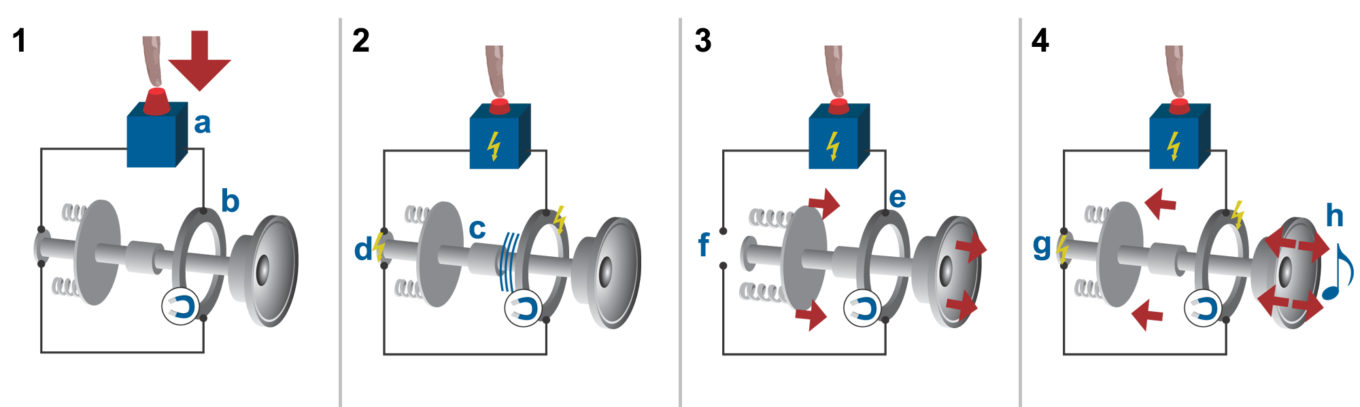
1. Pressing a button (a) closes the circuit in which an electromagnet (b) is located.
2. The resulting magnetic field moves another switch (c), which …
3. … immediately breaks the circuit again (d). This also causes the electromagnet (e) to deactivate immediately; it is then moved back to its original position by a return spring …
4. … is returned to its original position (f). This closes the switch again (g). This also closes the circuit once more, allowing the process to start over. The repetitive, oscillating motion is transmitted to a membrane (h), producing a sound.
Where is a Wagner hammer used?
Today, this principle is used less frequently, as modern electronics have taken over many of these tasks. Nevertheless, similar mechanical interrupters can still be found in certain applications.
Typical applications included: The principle continues to play a role, particularly in historical or simple electromechanical systems.
- electric doorbells
- buzzer
- relay technology
- ignition systems in older vehicles
- signal technology
This principle continues to play a role, particularly in historical or simple electromechanical systems.
Advantages of the Wagner Hammer
The Wagner Hammer has several practical features: As a result, the principle has been widely used for many decades.
- Simple mechanical design
- No complex electronics required
- Reliable pulse generation
- Low manufacturing costs
As a result, the principle has been widely used for many decades.
Disadvantages of the Wagner hammer
At the same time, the technology has some limitations: For this reason, many applications were later replaced by electronic circuits.
- Mechanical wear of the contacts
- Relatively high noise levels
- Sparking during switching
- Shorter service life than electronic systems
For this reason, many applications were later replaced by electronic circuits.
FAQ: Wagner Hammer
What does a Wagner hammer do?
A Wagner hammer generates electrical pulses by rapidly opening and closing an electrical circuit.
How does a Wagner hammer work?
An electromagnet pulls a contact toward it, thereby interrupting the flow of current. The contact then closes again. This process repeats continuously.
Where was the Wagner hammer used?
The principle was used in doorbells, relays, buzzers, and older ignition systems, among other applications.
Why is the Wagner hammer called that?
The name goes back to the German physicist Rudolf Wagner, who described the principle in the 19th century.
Is the Wagner hammer still used today?
Rarely in modern electronic systems. However, the basic principle can still be found in some electromechanical applications.