

Low beam
Low beam
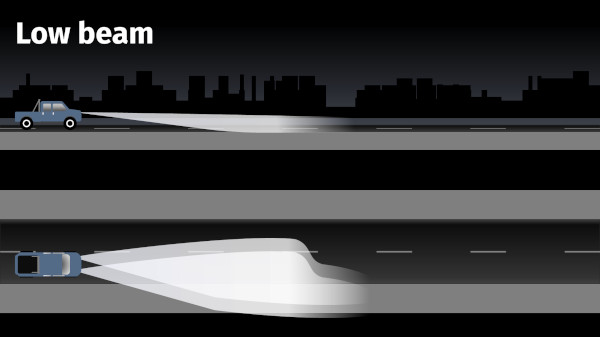
The low beam is a lighting function of headlights. It serves to illuminate the road ahead of the vehicle whilst simultaneously limiting the glare experienced by other road users.
To achieve this, the low beam has a characteristic light distribution with a defined cut-off line. Above this line, light output is significantly reduced. As a result, less light reaches the area where, for example, the eyes of oncoming drivers are located.
Asymmetrical low beam
In many headlights, the low beam is asymmetrical. In right-hand traffic, the right-hand side of the road is illuminated further or more intensely. This allows, for example, the edge of the roadway, road signs or people at the roadside to be spotted sooner.
For left-hand traffic, the light distribution is reversed accordingly. Therefore, a headlight or its adjustment must be suitable for the respective direction of traffic.
Further typical light distributions are shown in the article beam patterns of headlights.
Difference from high beam
The high beam differs from the low beam primarily in its light distribution. They are designed to illuminate the road ahead as far as possible and do not have a comparable cut-off line to limit the glare for oncoming road users.
Low beam headlights can therefore be used even in the presence of oncoming traffic, whilst high beam headlights must be dimmed if other road users could be dazzled.
Legal requirements
Defined photometric requirements apply to low beam headlights on public roads. These include, amongst other things, specifications regarding light distribution, the cut-off line and the permissible luminous intensity in specific areas.
Within the scope of the ECE Regulations, UN Regulation No. 149 in particular sets out the relevant photometric requirements for headlights. Requirements for their fitting to the vehicle are governed, amongst other things, by UN Regulation No. 48.
A headlight that has been type-approved for road use bears the relevant markings on the lamp or an ECE approval mark.