

Beam patterns of headlights
Photographs of driving beams
The beam pattern of a headlight describes how its light is distributed in front of the vehicle. The light distribution is tailored to the respective lighting function.
In the case of driving beams for road traffic, the light cannot be distributed arbitrarily. It is designed to provide the driver with adequate visibility whilst minimising the glare experienced by other road users.
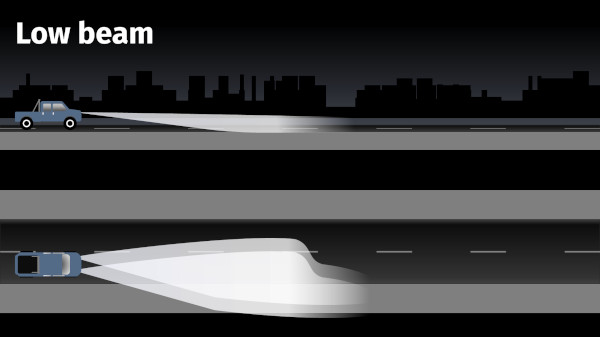
Low beam
Low beam illuminates the carriageway in front of the vehicle. Its light distribution has a defined cut-off line. In particular, this limits the light emitted in the direction of oncoming road users.
With asymmetrical dipped beam, the side facing the kerb is additionally illuminated. For this reason, a distinction must be made, amongst other things, between headlamps for right-hand and left-hand traffic.
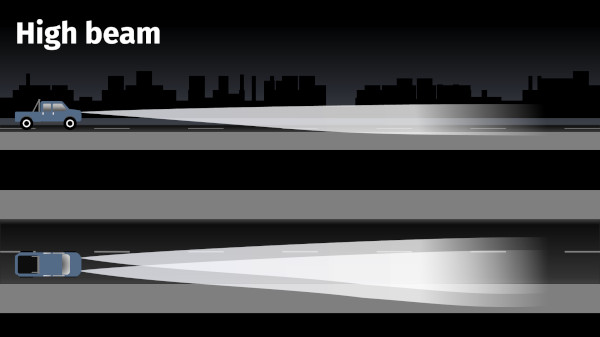
Main beam
High beam headlights are used to illuminate the road ahead over a long distance. Unlike dipped-beam headlights, they do not have a comparable light-dark boundary to limit the glare for oncoming road users.
High beam headlights must therefore only be used if they do not dazzle other road users.
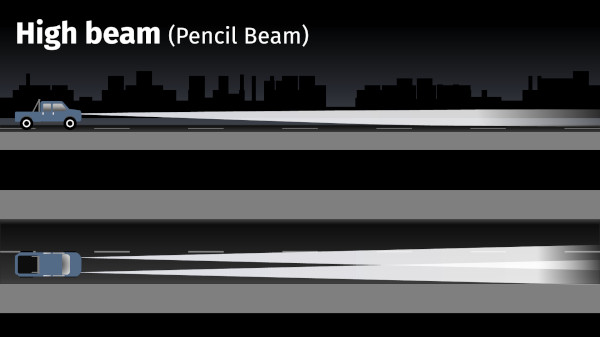
Pencil Beam
A particularly tightly focused light distribution can be designed as a pencil beam. In this design, the light is concentrated onto a comparatively narrow area. This enables a high luminous intensity in the main beam direction and a long range to be achieved.
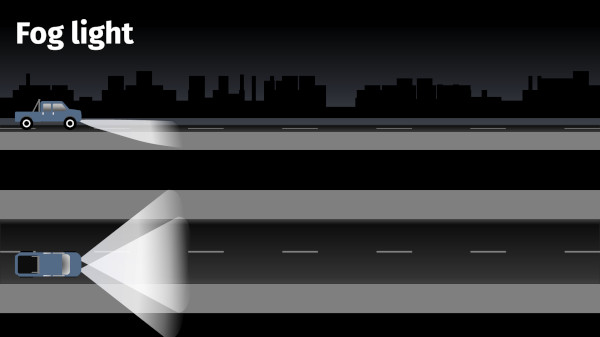
Fog light
The fog light is used to illuminate the road in poor visibility conditions. The light distribution of a fog light is wide and clearly limited towards the top. Consequently, the light pattern differs from both dipped beam and main beam.
Statutory requirements for light patterns
The light distribution of headlamps for road traffic is subject to defined photometric requirements. Among other things, luminous intensities at specified measurement points and in certain areas, as well as the characteristics of the cut-off, are tested.
For headlamps with dipped and main beam functions, as well as for front fog lamps, UN Regulation No. 149 in particular sets out the relevant requirements. These are to be distinguished from the regulations governing the mounting and circuit configuration of lighting equipment on the vehicle. These are governed, amongst other things, by UN Regulation No. 48.
Photometry provides the measurement parameters and procedures with which light distributions can be objectively described and assessed. It depends not only on its light output, but above all on the intended application and the required light distribution.