

Mounting height
How does the mounting height affect a lamp?
The mounting height determines the area illuminated by a light. It should therefore be considered in conjunction with the mounting position and the alignment of the spotlight. Particularly in the case of work lights, the same model can illuminate different areas of the working environment depending on its mounting position.
Mounting height and light distribution
The beam pattern of a light is determined by its optics. The mounting height does not fundamentally alter this light pattern, but it does affect the position and extent of the area illuminated. If a downward-facing headlamp is mounted higher up, the light travels a greater distance to reach the work surface. This allows a larger area to be illuminated. At the same time, the illuminance achieved on the surface may be lower.
The extent to which these effects are noticeable depends on the light distribution and the alignment of the spotlight.
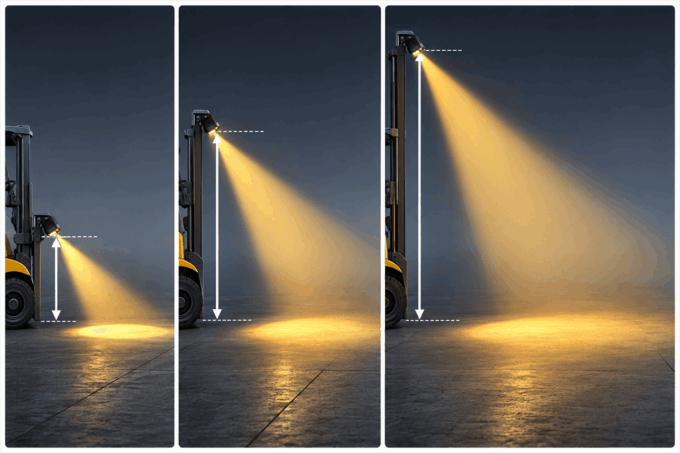
The angle of inclination is also crucial
The mounting height alone does not determine where a spotlight’s beam falls. Its angle of inclination is also crucial. A work light tilted more sharply downwards tends to illuminate an area closer to the vehicle. A flatter angle can shift the beam further away from the vehicle. The mounting height and angle of inclination should therefore be adjusted together to suit the desired working area.
Mounting height in the illumination diagram
The effects of the mounting position can be assessed using an illumination diagram. It shows the illuminance achieved at different positions, thereby illustrating how the light is distributed across the work area.
When comparing different illuminance diagrams, the specified installation conditions should be taken into account. A diagram created for a specific installation height and orientation cannot simply be applied to a significantly different installation situation.
What is the correct mounting height?
There is no universally applicable optimal mounting height for work lights. It depends, amongst other things, on the vehicle, the available mounting location, the beam pattern of the lamp and the work area to be illuminated.
When selecting and positioning a spotlight, one should therefore not consider only the luminous flux or the specification in lumens. The decisive factor is whether the light pattern, mounting position and orientation together produce the desired illumination.