

Reflector
A reflector is an optical component that directs light in a specific direction by reflection. In a light, the light source is situated in front of or within a reflective surface. The shape of this surface largely determines the directions in which the incident light is directed.
Unlike a lens, which primarily influences light through refraction, a reflector utilises reflection off a surface. The law of reflection generally applies here: the angle of incidence of the light beam is equal to the angle of reflection.
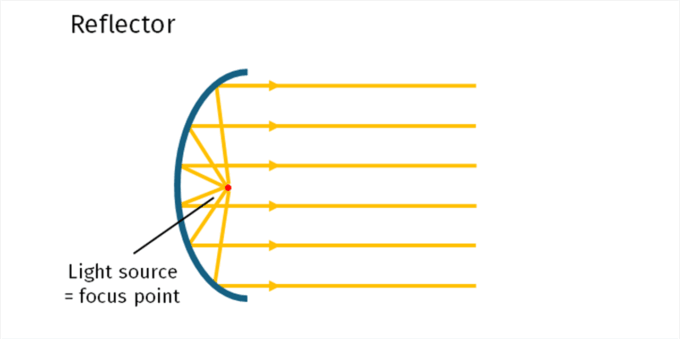
Shape of the reflector
The shape of the reflective surface allows the distribution of light to be specifically controlled. A well-known example is the parabolic reflector: if a point light source is situated at its focal point, the light rays reflected by the reflector are, ideally, aligned so as to be approximately parallel.
However, real-world lights do not necessarily use simple parabolic reflectors. Modern reflectors can consist of numerous sub-surfaces of varying shapes, which direct individual areas of the generated light specifically in different directions. In this way, the reflector helps to produce the desired beam pattern.
Reflectors in lights
Reflectors are used in both traditional halogen and gas-discharge lights as well as in LED lights. Depending on the optical system, the reflector plays a varying role in light shaping and can be combined with lenses or other optical elements.
The shape and properties of the reflective surface influence how efficiently the luminous flux generated by the light source can be utilised to achieve the desired light distribution.