

Lens
A lens is an optical component that influences light through refraction. When light strikes the interface between two transparent materials with different indices of refraction, its direction of propagation changes. The precisely shaped surfaces of a lens allow light to be focused, diverged or otherwise directed.
In lights, lenses are used to specifically influence the light produced by the light source and, in conjunction with other optical components, to produce the desired beam pattern. Depending on the optical system, they work in conjunction with, for example, a reflector or other light-directing elements.
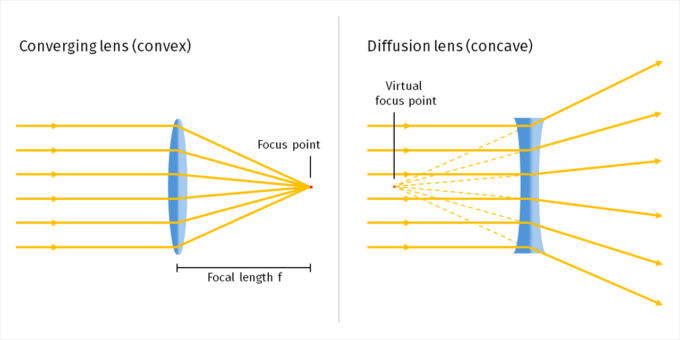
Converging and diverging lenses
Depending on its shape, a lens can influence light in different ways. A converging lens (convex lens) is thicker in the centre than at the edges. Parallel rays of light are refracted in such a way that they converge at a focal point behind the lens.
A diverging lens (concave lens), on the other hand, is thinner in the centre than at the edges. Parallel rays of light are diverged by it. Behind the lens, the rays of light appear to emanate from a common, virtual focal point in front of the lens.
In real lights, the optical elements often have much more complex shapes. Converging and diverging lenses therefore describe fundamental principles of light guidance and do not necessarily correspond to the specific shape of a modern light optical system.
Lenses in modern lights
In addition to conventional lenses, modern lighting systems utilise a variety of specially shaped optical elements. In LED lights, for example, individual LEDs or groups of LEDs can be combined with their own optical elements. This allows the light distribution to be precisely shaped very close to the light source.
It is therefore not the lens as an individual component that is decisive, but the interaction between the light source and the entire optical system. This determines how the generated luminous flux is spatially distributed and utilised for the respective lighting task.