

Colour temperature
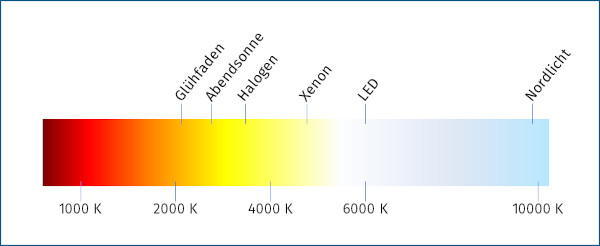
Colour temperature describes the colour of light emitted by a light source based on the temperature of a so-called blackbody or Planckian radiator. It is expressed in kelvins (K).
A black body is a theoretical physical model. When heated, the colour of the radiation it emits changes. As the temperature rises, the visible colour impression changes from reddish and yellowish tones through white to a bluish-white.
Correlated Colour Temperature (CCT)
For many technical light sources, particularly LEDs, the light colour does not correspond exactly to the radiation of a blackbody. For this reason, the correlated colour temperature (CCT) is usually used.
The CCT corresponds to the temperature of the Planckian radiator whose light colour comes closest to that of the light source in question within the relevant colour space.
A low value (up to approx. 3,000 K) indicates a rather warm colour impression, appearing yellowish to reddish. A high value (from approx. 5,000 K), on the other hand, describes a rather cool, bluish colour impression.
Typical ranges include, for example:
- approx. 2,700–3,000 K: warm white
- approx. 4,000 K: neutral white
- approx. 5,000–6,500 K: daylight white to cool white
The exact designation of these ranges may vary depending on the application and the relevant standard or manufacturer’s specifications.
Colour temperature and luminous flux
Colour temperature describes exclusively a property of the colour of light. It does not indicate the luminous flux produced by a light source or the illuminance achieved on a surface.
Two lights can therefore have the same colour temperature yet exhibit completely different photometric properties.
Nor can the quality of colour rendering be deduced from the colour temperature. The colour rendering index, amongst other things, is used for this purpose.
Colour temperature in work lights
In work lights, colour temperature influences the colour impression of the light produced and thus also the visual perception of the working environment.
However, the colour temperature suitable for a particular application cannot be determined solely on the basis of a Kelvin value. In addition to light colour, factors such as light distribution, illuminance, colour rendering, ambient conditions and the specific visual task also play a role.